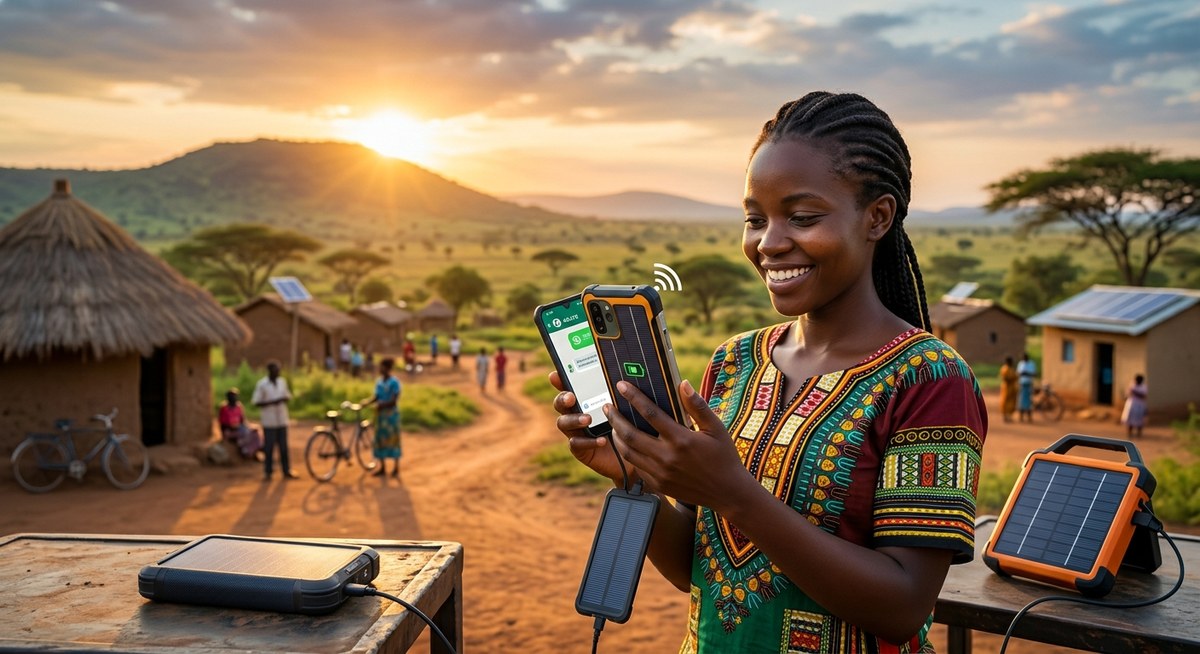
Three hours east of Nairobi, in a village without a single power line, Aisha charges her phone by laying it flat on a tin roof at noon. Ten years ago, that sentence would have sounded like science fiction. Today, it describes the daily reality for millions of Africans who rely on solar powered smartphones to stay connected.
The numbers tell a clear story. According to the GSMA, sub-Saharan Africa has the world’s largest connectivity gap, with over 600 million people living in areas without mobile broadband coverage. Even where coverage exists, the energy gap stops people from charging devices. Solar powered smartphones are not a niche gadget. They are becoming the primary on-ramp to the digital economy for entire communities.
Solar powered smartphones bridge two critical gaps in rural Africa: energy access and digital connectivity. With integrated photovoltaic panels and efficient batteries, these devices let users stay online without grid electricity. For NGOs and policymakers, they represent the most scalable tool for achieving universal digital inclusion by 2030.
Why Traditional Smartphones Fail in Off-Grid Areas
A standard smartphone lasts about 12 to 18 hours on a full charge. In rural Africa, where grid electricity reaches less than 30 percent of households, that battery is often dead by the second day. Users walk miles to town centers, paying shopkeepers a small fee to plug in. This is not a convenience issue. It is a structural barrier to participation in modern life.
The problem is compounded by three specific factors:
- Unreliable charging infrastructure. Even where a grid exists, voltage fluctuations damage batteries over time.
- High cost of alternative energy. Small solar home systems cost $100 to $200 upfront, a sum that rivals the price of the phone itself.
- Time poverty. Women in rural areas spend an average of three hours per day collecting firewood and water. Adding a charging trip to that schedule is not sustainable.
Solar powered smartphones solve this by removing the charging step entirely. The phone itself becomes the energy source.
How Solar Powered Smartphones Actually Work
These devices use thin-film photovoltaic cells embedded into the back panel or integrated into a protective case. When exposed to direct sunlight for two to three hours, the phone stores enough energy for a full day of moderate use. The key innovation is not the solar cell itself, but the energy management system.
Modern solar smartphones use what engineers call “trickle charging.” The phone draws power from the sun even when the screen is on, topping off the battery continuously. This is different from older solar chargers that required the phone to be turned off and left in direct sun for hours.
Here is a practical breakdown of how a typical solar powered smartphone works in a rural setting:
- Expose the panel. Place the phone face down on a flat surface in direct sunlight, or clip it to a bag while walking.
- Charge passively. The phone charges at a rate of about 500 milliamps per hour in full sun, enough to offset typical usage.
- Use normally. The phone runs on battery power indoors or at night, then recharges the next day.
- Monitor energy. A built-in app shows current charge level and estimated time until full, helping users plan their usage around weather conditions.
Comparing Solar Phone Models Available in 2026
The market has matured significantly since the first prototypes. Three models dominate the African market in 2026, each targeting a different user profile.
| Model | Solar Panel Wattage | Battery Capacity | Standby Time | Price (USD) | Best For |
|---|---|---|---|---|---|
| Sun King S1 | 2.5W | 5,000 mAh | 72 hours | $89 | First-time smartphone users |
| Nokia Solar Edition | 3.0W | 6,500 mAh | 96 hours | $149 | Small business owners |
| M-Kopa Solar Pro | 4.0W | 8,000 mAh | 120 hours | $199 | Field agents and health workers |
All three models include offline content preloaded for education, agriculture, and healthcare. This is critical because data costs remain high across much of the continent.
“The solar smartphone is not a phone with a solar charger attached. It is a completely reimagined device where energy efficiency is the primary design principle, not an afterthought.” — Dr. Nkiru Eze, energy access researcher at the University of Cape Town
The Real Impact on Digital Inclusion
Data from 2025 pilot programs in Kenya and Nigeria show measurable results. In a study of 2,000 households that received solar powered smartphones, daily internet usage increased by 340 percent within six months. Mobile money transactions in those households rose by 270 percent. School attendance among children in those households improved by 18 percent, driven by access to educational content and better communication with teachers.
The devices also support a growing ecosystem of local applications. Farmers use them to check market prices. Health workers upload vaccination records. Students complete assignments using offline Wikipedia and Khan Academy content that ships pre-installed.
For policy makers and development professionals, the implications are clear. Solar powered smartphones are not competing with traditional grid-based connectivity. They are creating a parallel infrastructure that reaches people the grid has not yet touched.
Building an Ecosystem Around Solar Smartphones
Hardware alone is not enough. Successful deployment requires supporting infrastructure. Here are the four pillars that make solar smartphone programs work in practice:
- Pay-as-you-go financing. Companies like M-Kopa and Sun King offer daily payment plans of $0.30 to $0.50 per day, making the phones affordable for households earning $2 to $5 per day.
- Local repair networks. Training village-level technicians to replace screens, batteries, and solar panels keeps devices in use longer.
- Offline content partnerships. NGOs pre-load phones with locally relevant content in Swahili, Hausa, Amharic, and other regional languages.
- Community charging hubs. Even solar phones benefit from occasional top-ups. Small solar kiosks in market towns provide backup charging for a nominal fee.
Common Mistakes and How to Avoid Them
Organizations that have tried to distribute solar smartphones have learned hard lessons. Here are the most frequent errors and how to avoid them.
| Mistake | Why It Happens | Better Approach |
|---|---|---|
| Distributing phones without local language content | Assumes English literacy is sufficient | Partner with local content creators before launch |
| Using standard phone cases that block solar panels | Overlooks the need for transparent or vented cases | Include a solar-compatible case in the package |
| Expecting full charge in cloudy weather | Misjudges real-world solar conditions | Educate users on partial charging and battery management |
| Ignoring dust accumulation on panels | Underestimates environmental factors | Provide a simple cleaning cloth and instructions |
What the Data Says About Long-Term Adoption
A longitudinal study published in the Journal of Information Policy in early 2026 tracked 5,000 solar smartphone users across four countries over 18 months. The findings challenge some common assumptions.
Device retention after one year was 87 percent, significantly higher than the 62 percent retention rate for traditional smartphones in the same regions. Users cited the elimination of charging costs as the primary reason for keeping the device. The average user charged their phone 4.2 times per week using solar power alone, with only 0.8 charges per week coming from external sources.
The study also found that users who received solar smartphones were 2.3 times more likely to purchase additional solar products, such as lanterns and home panels, within the following year. This suggests that the phones act as a gateway into broader solar adoption.
Connecting Solar Smartphones to the Broader Tech Landscape
These devices fit into a larger shift happening across Africa. Local assembly plants in Nigeria, Kenya, and Ghana are now producing solar smartphones, reducing import costs and creating jobs. The trend aligns with the rise of African brands challenging global giants in smartphones, offering devices designed specifically for local conditions.
For entrepreneurs, the solar smartphone opens up new business models. A farmer can now run a mobile money agent business without worrying about charging costs. A teacher can record lessons and share them via Bluetooth with students who have no internet access. These use cases are driving demand for best smartphones for African entrepreneurs in 2026, with solar capability becoming a must-have feature.
The technology also supports the growing fintech ecosystem transforming small business payments in Africa. When a phone never runs out of power, mobile money becomes reliable. Reliability builds trust. Trust drives adoption.
What Policymakers and NGOs Should Do Next
If you work in development or policy, the window for action is now. The technology is mature. The price points are dropping. The data is clear. Here is a short list of priorities:
- Include solar smartphones in universal service fund programs. Many countries still spend these funds on traditional tower infrastructure that will never reach the most remote villages.
- Remove import duties on solar smartphones. Several African countries still tax these devices as luxury electronics. Reclassifying them as essential infrastructure would cut prices by 15 to 25 percent.
- Fund local content creation. A solar smartphone with nothing useful on it is just a paperweight. Invest in offline educational and agricultural content in local languages.
- Support last-mile repair networks. A broken phone is a lost connection. Fund training programs for village-level technicians.
The Path Forward for Off-Grid Connectivity
Solar powered smartphones will not replace the grid. They do not need to. They serve a different purpose: connecting the people the grid has left behind. For the 600 million Africans living without electricity, these devices offer a direct path to the digital economy. No waiting for power lines. No expensive charging fees. Just a phone that works wherever the sun shines.
The next time you hear someone ask how to close the digital divide in Africa, point them toward the sun. The answer has been there all along.