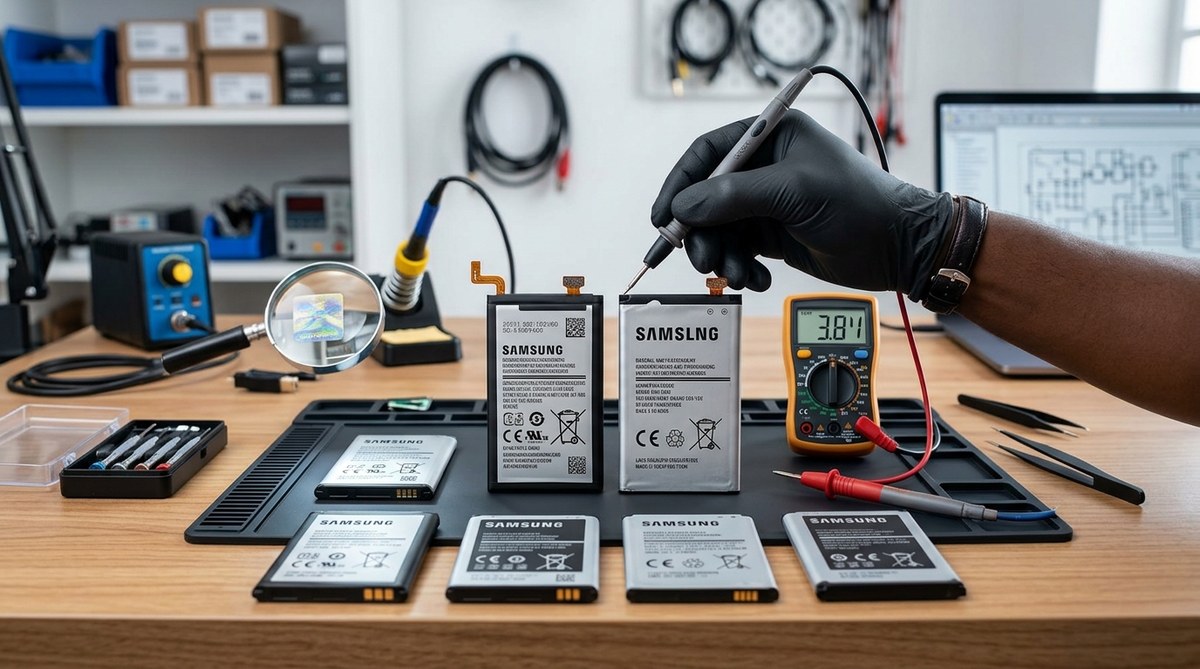
A swollen phone, a sudden shutdown, or a battery that dies after an hour. If you have ever bought a replacement battery from a street vendor in Lagos, a phone shop in Nairobi, or a marketplace in Accra, you have probably wondered whether you got a genuine product or a dangerous copy. Counterfeit batteries are everywhere across Africa, and they do more than waste your money. They can overheat, leak, or even explode. The good news? You do not need a lab to tell the difference. With a few simple checks, you can protect yourself and your device.
Fake smartphone batteries are a serious safety risk in Africa. You can spot them by checking weight, print quality, fit in the phone, and performance during charging. Always buy from authorized dealers, inspect the packaging carefully, and run a basic voltage test if possible. A small upfront check can prevent a fire, a damaged phone, or a wasted purchase.
The Real Cost of a Fake Battery
Imagine you are at a bustling market in Kigali. You find a battery for half the price of the official store. It looks right. The sticker seems shiny. You buy it. Two weeks later, your phone feels hot to the touch. The back cover bulges. Then the screen cracks from internal pressure. That is not bad luck. That is a counterfeit battery.
Fake batteries skip quality control. They use low grade components. They lack safety circuits that stop overcharging. In 2026, with more Africans using smartphones for everything from mobile money to remote work, a faulty battery puts more than a device at risk. It threatens your data and your safety. The Interpol and local consumer agencies have warned about a surge in counterfeit electronics across the continent. Knowing how to spot them is not optional. It is a basic skill for any smartphone owner.
How to Spot a Fake Battery: A Step by Step Guide
When you pick up a battery, use your senses first. Then move to simple tests. Follow this numbered process every time.
-
Check the weight. A genuine lithium ion battery has a specific density. Counterfeiters often use cheaper materials that make the battery lighter or sometimes heavier with extra filler. Hold the battery in your hand. Compare it to the original if you have it. If it feels noticeably off, walk away.
-
Inspect the label and print. Real batteries have crisp text, consistent fonts, and official logos. Fakes have blurry print, misspellings, or awkward spacing. Look at the model number. Does it match the one your phone uses? Many fakes use a generic number like “BL 5C” for any phone. Also check the hologram or scratch off code. Genuine batteries from Samsung, Tecno, Infinix, and Nokia often include a verification scratch panel. Scratch it and text the code to the manufacturer’s hotline. If the code is rejected or already used, the battery is fake.
-
Test the fit. Insert the battery into your phone. A genuine battery slides in smoothly and locks with a satisfying click. A fake is often slightly too thick, too thin, or has poor alignment. It may wobble or require force to insert. If the battery does not fit perfectly, do not force it. That extra pressure can damage the phone’s connectors.
-
Run a charging test. Connect your phone to a charger and time how long it takes to reach full charge. Genuine batteries follow a predictable curve. Fakes may charge in 30 minutes (dangerous) or take forever. Also monitor the temperature. If the battery gets hot during normal charging, that is a red flag. A real battery warms up slightly, but it should never be uncomfortable to touch.
-
Use a multimeter (if you have one). For a more technical check, measure the voltage of the battery right after a full charge. A standard lithium ion battery should read around 4.2 volts when full. If it reads below 4.0 or above 4.3, the battery lacks proper regulation. This is a clear sign of a counterfeit. Many phone repair shops in Africa have multimeters and can test a battery for you for a small fee.
Signs to Scan When Shopping
Look for these warning signs before you hand over your money. Use this list as a mental checklist.
- The price is too good to be true. If a battery costs less than half the official price, it is almost certainly fake.
- The seller has no packaging or the packaging looks reused. Real batteries come in sealed boxes with clear branding.
- The battery has no safety certification marks like CE, FCC, or the manufacturer’s own logo.
- The battery contacts look tarnished or scratched. Genuine contacts are shiny and clean.
- The plastic casing has rough edges or visible glue.
- The model number on the battery does not match any known model for your phone brand.
Quick Comparison: Genuine vs. Fake Battery Features
| Feature | Genuine Battery | Fake Battery |
|---|---|---|
| Weight | Consistent with specs (e.g., 35g for a typical 3000mAh) | Often lighter or heavier by 5g+ |
| Print quality | Sharp, uniform, no smudging | Blurry, misaligned, smudged ink |
| Hologram/scratch code | Present, verifiable via manufacturer SMS | Missing or code refuses |
| Fit in phone | Snug, no extra movement | Loose or too tight |
| Charging time (0 to 100%) | 1.5 to 2.5 hours for standard charger | <1 hour or >4 hours |
| Temperature during charge | Warm, not hot | Hot to the touch |
| Voltage at full charge | 4.18 to 4.22V | Below 4.0V or above 4.3V |
Expert Advice from a Phone Technician in Nairobi
“I see at least two fake batteries a week. Customers bring in phones that won’t turn on or have bulging backs. Nine times out of ten, it is a counterfeit battery. My best advice: never buy a battery that is not sealed in its original packaging. And if the seller says ‘it’s the same as original,’ ask for the scratch code. If they hesitate, leave.”
— Kevin Mwangi, owner of Mwangi Phone Repairs, Nairobi, Kenya.
Kevin’s point is critical. Many street vendors will claim their batteries are “original” or “high quality copies.” But there is no such thing as a high quality copy. A copy is a counterfeit. It does not meet safety standards.
Where to Buy Genuine Smartphone Batteries in Africa
Your safest bet is an authorized service center for your phone brand. Tecno, Infinix, Samsung, and Nokia have official repair partners in major cities like Lagos, Accra, Nairobi, Johannesburg, and Addis Ababa. Prices are higher, but you get a warranty and a genuine product. If you buy online, stick to well known platforms like Jumia or Konga, but always check seller ratings and read reviews specifically about battery authenticity. Avoid “too good to be true” deals from unknown stores. You can also check our article on top 10 budget smartphones dominating the African market in 2026 to see which brands have the best support networks.
What to Do If You Already Have a Fake Battery
If you suspect your current battery is fake, stop using it immediately. Remove it from the phone. Store it in a cool, dry place away from flammable materials. Do not puncture it or throw it in the trash. Many electronics shops in Africa accept old batteries for recycling. Some municipalities have e waste collection points. If you cannot find one, wrap the battery in tape and drop it at a phone repair shop. They often have contacts for proper disposal.
Replace the battery with a genuine unit. Your phone’s performance and safety depend on it. If you are not sure which phone model to buy next, read our guide on how to choose the right smartphone for your business in Africa.
Staying Ahead of the Counterfeit Game
Fake battery makers get better every year. In 2026, some fakes even imitate holograms. But they still cannot match the precision of an original manufacturer. Arm yourself with knowledge. Share these tips with friends and family. The more people who know how to spot a fake, the harder it becomes for counterfeiters to sell their dangerous products. If you want to learn more about what technologies are changing the smartphone landscape, check out emerging smartphone features transforming connectivity in Africa.
Your Phone Deserves a Safe Power Source
That battery inside your phone works hard every day. It powers your calls, your mobile money transfers, your social media, and your work. Do not trust it to a cheap knockoff. Spend the extra few dollars. Take the time to verify. Your phone and your safety are worth it. Next time you need a replacement battery, run through these checks. You will leave the market with confidence, not regret. And if you are curious about how to get the most out of a genuine battery, our guide on how to extend your smartphone’s battery life in Africa’s harsh climate will help you keep it healthy for years.