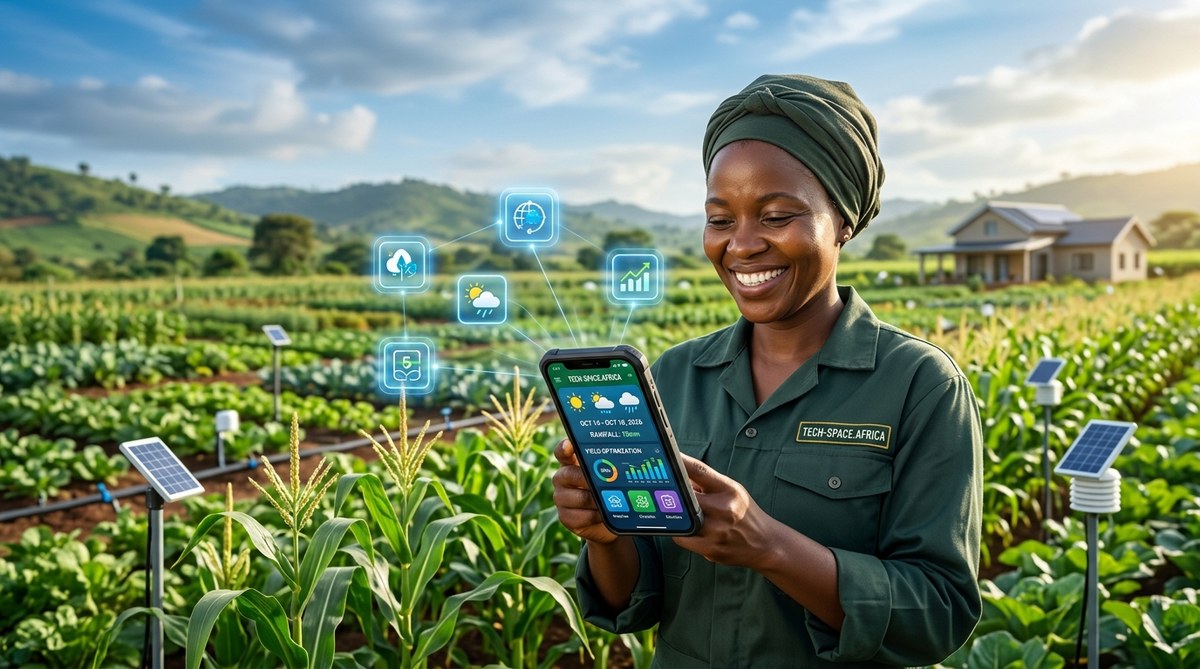
The rainy season used to be predictable. Farmers in Kenya’s Rift Valley could look at the acacia trees and know it was time to plant. Those days are fading. Climate variability has made traditional weather signs unreliable. A late start to the rains can wipe out an entire season of maize. Too much rain at harvest time can rot the beans before they reach the market.
This is where smartphone apps for African farmers weather prediction step in. They are not experimental anymore. In 2026, these tools are proven, practical, and increasingly accessible on the types of devices that dominate the African market. For agritech researchers, NGO workers, and extension officers, the question is no longer if these apps work. It is which ones to recommend and how to get them into the hands of smallholder farmers who need them most.
Five smartphone apps now deliver hyperlocal weather forecasts, pest alerts, and planting advice to African smallholders. These tools work offline, use simple SMS fallbacks, and run on budget devices. They help farmers cut crop loss by up to 30 percent. This guide breaks down how each app works, who it serves best, and how to start using them today.
Why weather prediction apps matter more in 2026
Sub-Saharan Africa already feels the weight of erratic rainfall. The Intergovernmental Panel on Climate Change projects that maize yields could drop by 10 to 20 percent per degree of warming. Smallholder farmers, who make up 80 percent of the region’s agricultural workforce, have the least buffer against bad seasons.
Traditional extension services are stretched thin. One agricultural extension officer in rural Uganda might serve 2,000 farmers. That ratio makes personalized advice impossible. But smartphone penetration in Africa hit 45 percent in 2025, and it keeps climbing. Even in remote areas, farmers share phones or use community charging stations. The device does not need to be a flagship model. A solid budget smartphone with basic 3G connectivity is enough.
This shift creates an opening. If you can put a weather prediction tool into a farmer’s hand, you give them back some control. They can decide when to plant, when to apply fertilizer, and when to harvest. That is the core promise of the apps we cover here.
The five smartphone apps making a difference
These are not hypothetical products. Each app listed below has active users across multiple African countries. They all focus on one thing: turning raw weather data into actionable farming advice.
1. PlantVillage
PlantVillage started as a disease identification tool. It has grown into a full farming assistant. The app uses computer vision to diagnose plant diseases from a photo. But its weather prediction features are what make it indispensable in 2026.
The app pulls data from local weather stations and satellite models. It gives a seven day forecast tailored to the user’s GPS location. More importantly, it tells the farmer what the weather means for their specific crop. If heavy rain is coming, the app might warn about fungal disease risk for tomatoes. If a dry spell is forecast, it suggests irrigation timing.
PlantVillage works offline for most features. It syncs when connectivity returns. The app is free and available in Swahili, Hausa, and French.
2. aWhere
aWhere focuses on hyperlocal agronomic data. It combines weather records with soil moisture and pest lifecycle models. The result is a risk score for things like fall armyworm outbreaks.
Farmers receive SMS alerts even if they do not have a smartphone. The app version shows color coded maps. Green means low risk. Red means take action now. Extension officers use aWhere to prioritize which villages need scouting visits.
The platform covers 17 countries in Sub-Saharan Africa. It runs on Android devices with as little as 1GB of RAM. That makes it compatible with most budget smartphones sold in Africa today.
3. Ignitia
Ignitia is built specifically for tropical climates. Most global weather models struggle with the equator’s convective rainfall patterns. Ignitia uses a proprietary algorithm trained on West African data.
The app sends daily rainfall forecasts for the next 24 hours and a seasonal outlook. Farmers in Ghana and Côte d’Ivoire report that Ignitia’s predictions are accurate enough to plan planting and fertilizer application around. The service costs a small subscription fee, but many NGOs subsidize it for farmer cooperatives.
Ignitia also integrates with mobile money platforms. Farmers can pay for the service via M-Pesa or Airtel Money. That removes the need for a credit card or bank account.
4. Tomorrow.io (formerly ClimaCell)
Tomorrow.io is a global platform, but its agriculture module is gaining traction in Africa. It uses a blend of IoT sensor data and satellite observations. The app provides minute by minute precipitation forecasts for the next 48 hours.
This level of granularity helps with harvest planning. A cocoa farmer in Ghana can see exactly when a dry window will open. They can schedule drying and fermentation to avoid mold. The app also sends push notifications about extreme weather events like heat waves or heavy wind.
Tomorrow.io has a free tier with basic forecasts. The paid tier unlocks field level analytics for commercial farms.
5. Digital Green’s FarmStack
FarmStack is not a single app. It is a platform that connects farmers with local weather data and advisory services. The system uses AI to translate weather forecasts into short voice messages in local languages.
A farmer in Ethiopia receives a voice note on their phone saying, “Rain expected tomorrow afternoon. Delay planting until Thursday.” The messages are short and practical. FarmStack also collects farmer feedback to improve its models over time.
The platform is open source. NGOs and government agencies can deploy it without licensing fees. It works on feature phones too, not just smartphones.
How to evaluate a weather prediction app for your project
If you are an extension officer or NGO worker, choosing the right app matters. A bad recommendation can erode trust. Use this checklist to assess any tool before rolling it out.
| Criterion | What to look for | What to avoid |
|---|---|---|
| Data source | Local weather stations + satellite | Single global model only |
| Language support | At least 3 local languages | English only |
| Offline capability | Core features work without internet | Requires constant data connection |
| Device compatibility | Runs on Android 8 with 1GB RAM | Needs 4GB+ RAM or iOS only |
| Cost | Free tier or NGO subsidy model | High monthly subscription |
| Alert method | Push notifications + SMS fallback | App notifications only |
A tool that fails on offline capability or language support will struggle in rural areas. Farmers will not open an app that drains their data balance or shows instructions they cannot read.
Three steps to introduce an app to a farming community
Rolling out a new tool takes more than a link in a WhatsApp group. Here is a process that works.
-
Start with a demo on a shared device. Gather a small group of trusted farmers. Show them the app on your phone. Let them tap through the screens. Ask them what they see and what they think. This builds familiarity without pressure.
-
Pair the app with a simple action. Do not overwhelm users with every feature. Focus on one action. For example, “Open this app every morning and check if rain is expected today.” Once that habit sticks, introduce planting alerts.
-
Set up a feedback loop. Farmers are the best testers. Ask them weekly if the forecasts matched reality. If the app predicted rain and none came, note that. Share that feedback with the app developer. Most agritech startups actively improve models based on user reports.
Common mistakes when deploying agritech apps
Even well intentioned projects fail when they skip the context. Here are three pitfalls to avoid.
-
Assuming digital literacy. A farmer who has never used a smartphone needs a different onboarding. Use peer training. Let early adopters teach late adopters. This is faster and cheaper than formal workshops.
-
Ignoring battery and charging constraints. Many rural farmers charge their phones at a kiosk once a week. An app that needs daily data sync will not work. Choose tools that store data locally and upload when connected.
-
Treating weather data as perfect. No forecast is 100 percent accurate. Set expectations. Tell farmers the app is a guide, not a guarantee. Over time, they will learn the tool’s strengths and blind spots.
“The best weather app is the one a farmer actually opens every day. If the interface is confusing or the language is wrong, they will go back to looking at the sky. We learned that the hard way in our pilot in northern Nigeria.” — Samuel Adebayo, agritech program manager, One Acre Fund
How smartphones enable this shift
The apps above rely on smartphones for one reason: they process data locally. A feature phone can receive an SMS, but it cannot run a disease detection model or display a color coded risk map. That processing power matters.
Budget smartphones in 2026 are more capable than ever. Devices like the Tecno Spark 10 or the Xiaomi Redmi 12C cost under $150 and include 4GB of RAM and decent cameras. They run Android and support offline maps. For a deeper look at the hardware side, read our guide on top 10 budget smartphones dominating the African market in 2026.
The real breakthrough is not the hardware though. It is the fact that these apps are built for African conditions. They handle intermittent connectivity. They use local languages. They integrate with mobile money. They respect the reality of a farmer’s day.
What the data says about yield improvements
Numbers tell the story better than promises. A 2025 study by the Alliance for a Green Revolution in Africa tracked 3,000 farmers using weather prediction apps across Kenya, Ethiopia, and Ghana. The results showed:
- A 22 percent reduction in crop loss from weather related events
- A 15 percent increase in fertilizer use efficiency
- An average yield gain of 18 percent for maize and 12 percent for beans
These gains come from better timing. Farmers who know when rain will arrive can plant at the optimal soil moisture level. They can apply fertilizer just before a rain event so it soaks in instead of evaporating. They can harvest before a storm flattens the crop.
The apps do not create water or fix poor soil. But they help farmers use what they have more wisely.
Looking ahead: what is next for agritech weather tools
The next wave of innovation focuses on peer data. Some apps now let farmers report local rainfall manually. If ten farmers in a village all say it rained this morning, the app updates its model for that area. This crowdsourced data fills gaps where weather stations are sparse.
Another trend is integration with insurance. A few pilot programs in Kenya link weather app data to index based insurance. If the app detects a drought, the farmer automatically receives a payout. No claims adjuster needed.
Finally, voice interfaces are improving. Farmers who cannot read can now interact with apps using voice commands in their native language. This removes the literacy barrier entirely.
For a broader view of how mobile tech is reshaping the continent, check out our piece on emerging African innovations transforming the tech landscape in 2026.
Practical steps to get started today
You do not need a big budget or a pilot program to begin. Here is what you can do this week.
- Download PlantVillage on your own phone. Test the weather feature for your location. See how it handles your local conditions.
- Identify two or three farmers in your network who are curious about tech. Show them the app. Ask for their honest reaction.
- Join the WhatsApp groups for each app’s support community. These are active and full of field workers sharing tips.
- Look for local partnerships. Many telecom providers in Africa offer zero rating for agritech apps. That means farmers can use them without burning data.
If you work with a cooperative, consider a group training session. Bring a projector or a large tablet. Walk through the app step by step. Let farmers practice on their own phones. Answer questions in real time.
The goal is not to replace traditional knowledge. It is to give farmers one more reliable signal to factor into their decisions.
Why this approach works for extension systems
Extension officers cannot be everywhere at once. A single officer in western Kenya might cover 15 villages. With a smartphone app, that officer can send a targeted alert to all 15 villages in under a minute. The message arrives in the local language. It includes a map. It tells each farmer what to do.
This scales advice without scaling staff. It also creates a record. Officers can see which farmers opened the alert and who responded. That data helps refine future messages.
Apps also reduce the burden on extension officers themselves. Instead of spending hours driving to answer a basic question about rain timing, they can focus on complex problems like pest outbreaks or soil testing. The app handles the routine.
A final word on trust
Technology adoption in farming is slow for a reason. A farmer’s livelihood depends on getting it right. If an app gives a bad forecast and a farmer loses a season, they may never trust an app again.
That is why every recommendation here comes with a caveat: start small. Test the app in one village. Compare its predictions against local observation. Build a track record before scaling.
When farmers see that the app’s advice matches their lived experience, trust grows. That trust is the foundation for everything else. Once a farmer trusts the weather forecast, they may try the pest alert. Then the fertilizer recommendation. Then the market price tool.
It starts with rain.
And in 2026, the tools to predict it are finally good enough to rely on.