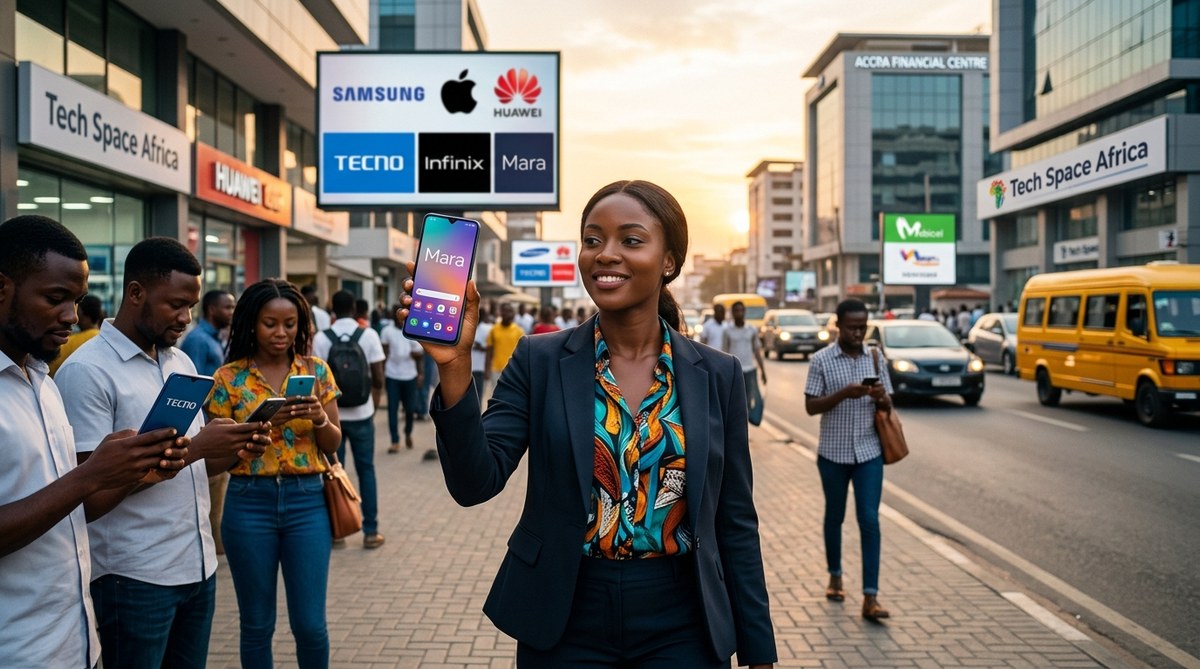
You have seen the numbers. Samsung, Apple, and Xiaomi dominate headlines worldwide. But in Africa, the story is different. Local brands and regionally focused manufacturers have quietly built a massive lead. They do not just compete. They win. In 2026, African smartphone brands are not only challenging global giants, they are redefining what a smartphone should be for a billion plus people.
Transsion’s three brands (Tecno, Infinix, itel) hold nearly 50% of Africa’s smartphone market in 2026. Newer homegrown players like Mara are gaining ground by focusing on affordability, local assembly, and features that matter to African users. Global giants are being forced to adapt or lose share.
The Rise of Transsion and Its Three Brands
You may not know the name Transsion Holdings. But if you walk through Lagos, Nairobi, or Johannesburg, you will see its phones everywhere. Tecno, Infinix, and itel together control close to half of Africa’s smartphone shipments as of early 2026. That beats Samsung and Apple by a wide margin.
How did a Chinese company become the unofficial king of African phones? It started with listening. Transsion understood early that African consumers were not happy with one size fits all devices. They wanted long battery life for frequent power cuts. They needed dual SIM slots because multiple network providers offered better coverage. They cared about camera algorithms that handled darker skin tones well.
These were not afterthoughts. They were the core design principles. Today, every Tecno and Infinix phone ships with these features as standard. Global brands are catching up, but they still lag behind in local polish.
How Local Brands Win with Features That Matter
Let us break down the specific advantages that African focused brands hold over global competitors. They are not just about price.
- Dual SIM plus dedicated memory slot: Most devices support two physical SIMs and a microSD card simultaneously. This is a must in markets where people switch networks to save on calls or data.
- Batteries above 5000 mAh: Power cuts are common. A phone that lasts two days on a single charge is not a luxury, it is a necessity.
- Camera tuning for dark skin: Transsion invested years in building algorithms that properly expose faces with melanin rich skin. Samsung and Apple have improved, but local brands still win user blind tests on social media.
- Local language support and preloaded apps: Interfaces in Swahili, Hausa, and Zulu are available out of the box. Music apps come with popular African streaming services preinstalled.
- Aggressive pricing below $100: itel offers smartphones for as low as $40. That puts a connected device in the hands of millions who would otherwise be locked out.
These features are not gimmicks. They are survival tools in daily African life. Global brands have started copying, but they cannot match the speed of iteration that local focused companies maintain.
Comparing Strategies: Global Giants vs. African Challengers
To see the difference clearly, here is a table that outlines the main areas where local brands outperform or match global players.
| Area | Global Giants (Samsung, Apple) | African Focused Brands (Tecno, itel, Infinix, Mara) |
|---|---|---|
| Price range | $150 to $1200+ | $40 to $300 (with some premium models up to $500) |
| Battery life | 3000 to 4500 mAh typical | 5000 to 7000 mAh standard |
| Dual SIM | Limited to mid range and above | Included in almost every model |
| Camera optimization | Good, but generic for global skin tones | Specifically tuned for African skin tones |
| Local software features | Limited to Google services | Preloaded local apps, content partnerships |
| After sales service | Sparse in rural areas | Extensive network of repair centers in smaller towns |
| Assembly location | Mostly outside Africa | Growing local assembly in Kenya, Ethiopia, Rwanda |
The numbers tell the story. In 2026, Transsion alone shipped over 80 million smartphones in Africa. Samsung shipped around 30 million. Apple’s share is under 5%.
Beyond Transsion: New African Challengers Rise
Transsion gets the most attention, but it is not the only player. A growing group of truly African brands are entering the market with their own assembly lines and design teams.
Mara Phones, based in Rwanda and with factories in South Africa and Ethiopia, launched its first smartphone in 2019. By 2026, Mara has released six models, all under $200. The company focuses on using local materials and creating jobs. Mara’s phones run near stock Android and offer two year warranties, something global brands rarely do at that price point.
Simmtronics, headquartered in Ghana, produces affordable tablets and smartphones. It targets the education sector, bundling preloaded learning apps for students. Another brand, Mi-Fone (now mostly a licensing brand), still has a presence in parts of West Africa.
These companies face huge challenges. They lack the scale to source components as cheaply as Transsion. Their marketing budgets are tiny. Yet they matter because they prove that African made phones are possible and desired.
For a new local brand trying to break into the market, the process looks like this:
- Identify a specific pain point that global or Transsion phones ignore, such as ruggedness for construction workers or a dedicated health tracker for rural clinics.
- Partner with a contract manufacturer in Asia for the first batch to keep costs low, then plan a local assembly facility within two years.
- Focus on one country first. Build strong distribution through mobile money agents and small kiosks, not just big retailers.
- Invest in community based customer support. Train local technicians. Replace or repair phones within 48 hours.
- Use social media and influencer marketing. African youth trust local creators more than traditional ads.
One industry observer with deep experience in African tech told us this:
“The brands that succeed here are the ones that treat Africa as a mosaic of different markets, not a single blob. What works in Nigeria might flop in Kenya. Local challengers win when they tailor everything from the charger plug to the default wallpaper to the city block where the phone is sold. Global giants still think a one size fits all approach will work. It will not.”
That quote comes from a conversation with a supply chain analyst who has worked with both Transsion and Samsung in East Africa.
Why Business Analysts and Tech Journalists Should Watch This Space
If you are researching the competitive landscape, the African smartphone market offers a rare case study. It shows how a focused strategy beats deep pockets. It also shows how quickly a dominant player can emerge when they solve local problems.
Transsion’s success has not gone unnoticed. Samsung has launched its Galaxy M and A series with larger batteries and dual SIMs specifically for Africa. Apple now offers installment plans through mobile money platforms like M-Pesa. But the gap remains wide.
Understanding these dynamics helps you predict where other industries might follow. The smartphone story is repeating in solar home systems, digital payments, and even electric motorcycles. Localized product design plus patient distribution is a winning formula in Africa.
For deeper reading on specific models and price comparisons, check out our Top 10 Budget Smartphones Dominating the African Market in 2026. Or if you are a business owner, see our How to Choose the Right Smartphone for Your Business in Africa guide. For a broader look at where the industry is heading, we have The Future of Smartphone Technology in Africa: Trends to Watch in 2026.
The Road Ahead for African Smartphone Brands
The battle is far from over. Global giants have vast resources. They can lower prices or outspend on marketing. But African focused brands have something harder to copy: deep user trust and hyperlocal empathy.
Expect more local assembly lines to open in 2027. Expect new brands from countries like Nigeria and Ghana that focus on niche segments like gaming or elderly users. Expect Transsion to keep innovating, but also to face stiff competition from both sides.
For business analysts and journalists, the question is not whether African brands can challenge global giants. They already do. The real question is how long the incumbents will take to truly adapt. If you watch the African smartphone market closely, you are watching the future of global tech expansion unfold.
Stay curious. Stay tuned. And next time you see a Tecno or Mara phone, remember: behind it is a story of a company that chose to build for Africa first. That choice is paying off in a big way.