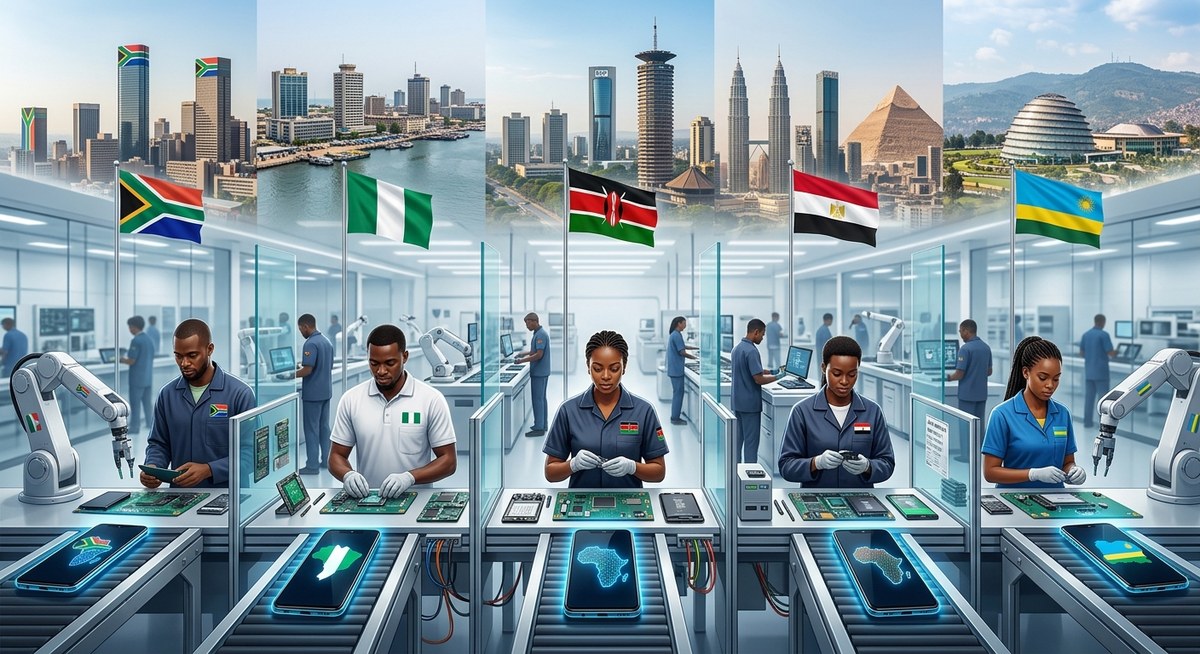
Africa’s local smartphone assembly scene is no longer a distant ambition. It is a fast-growing reality. In 2026, a handful of countries have turned policy, investment, and demand into working factories that piece together phones for their own populations and for neighbors. For tech investors and industry analysts watching the continent, this shift changes everything. Import duties shrink, supply chains shorten, and new players emerge. This article breaks down which countries are leading, how they got there, and what it means for the future of mobile connectivity in Africa.
Local smartphone assembly in Africa is accelerating in 2026, driven by government incentives, growing local demand, and partnerships with global brands. Egypt, South Africa, Kenya, Nigeria, and Ethiopia lead the pack, each with distinct strategies. For investors, the opportunity lies in components, logistics, and aftermarket services. Understanding each country’s strengths helps pinpoint where to place bets.
Why Local Assembly Matters Now
Africa imported more than 200 million mobile phones in 2025, according to industry estimates. That number came with a heavy price tag in foreign exchange and logistics. Local assembly changes the math. When a phone is assembled in Nairobi or Cairo, parts still come from abroad, but value addition stays home. Jobs are created. Skills are built. And the final device costs less because tariffs on semi-knocked down (SKD) kits are lower than on finished phones.
For an investor, the question is not if Africa will assemble phones locally, but which markets offer the most stable environment, the best talent, and the strongest demand. The five countries we cover below have answered that question with action.
The Five Countries Leading Local Smartphone Assembly in 2026
Egypt: The North African Manufacturing Hub
Egypt has been assembling phones for years, but 2026 marks a critical scale-up. The government’s Industrial Development Authority now offers tax holidays for electronics manufacturers that meet local content thresholds. Samsung runs a large plant in Beni Suef, producing millions of units annually. Newcomers like Vivo and Xiaomi have set up SKD lines near Cairo.
What makes Egypt stand out is its labor pool. Wages are competitive, and the country has a long history of light manufacturing. The Suez Canal provides access to Asian component suppliers. For investors, Egypt also offers a gateway to Arab League markets through the Pan-Arab Free Trade Area.
South Africa: Quality and Regional Reach
South Africa’s assembly industry is smaller in volume but strong in quality. The country hosts plants for Hisense, which makes TVs and smartphones in Cape Town, and for Mobicel, a local brand that has grown steadily. South Africa’s advantage is its sophisticated logistics network and its role as a hub for Southern Africa.
The government’s Industrial Policy Action Plan supports local assembly through procurement preferences. State-owned enterprises and large corporations must buy locally assembled devices first. That creates a captive market. South Africa also benefits from strong technical universities that train engineers for the electronics sector.
Kenya: Growth Through Innovation
Kenya’s assembly story is closely tied to the rise of affordable smartphones for mobile money users. Safaricom and local brand Neon Smart have partnered to produce devices under $50. The plant in Athi River, near Nairobi, operates with automated surface-mount technology (SMT) lines.
What sets Kenya apart is the mobile money ecosystem. M-Pesa drives demand for low-cost smartphones. The government’s Digital Economy Blueprint includes targets for locally assembled devices. Kenya also hosts the East African Community headquarters, giving it access to a market of over 300 million people.
Nigeria: The Giant Wakes Up
Nigeria has the largest population in Africa and one of the fastest-growing smartphone markets. But local assembly has been slow. That changed in 2025 when the government slashed import duties on SKD kits and provided land for industrial parks. By 2026, several plants are operational.
Oraimo and Tecno (Transsion) have set up assembly lines in Lagos and Ogun State. The challenge remains electricity and security, but the government has invested in solar mini-grids for industrial zones. For investors, Nigeria offers the most upside because demand is huge and the market is still underserved.
Ethiopia: The New Player with Big Ambitions
Ethiopia’s smartphone assembly is the newest and perhaps most surprising success. The government’s industrial parks strategy, which worked for textiles, is now applied to electronics. The Bole Lemi and Kilinto parks host plants for brands like Itel and Infinix.
Ethiopia offers cheap labor, low electricity tariffs, and preferential trade access to the US under the African Growth and Opportunity Act (AGOA). The country’s domestic market is growing fast as incomes rise. Analysts expect Ethiopia to become a major assembly hub for East Africa within three years.
What This Means for Investors and Analysts
The shift to local assembly creates opportunities across the value chain. Here are the key areas to watch:
- Component sourcing: As assembly grows, demand for screens, batteries, cameras, and casings will rise. Local suppliers that can produce these parts will find ready buyers.
- Logistics and distribution: Companies that move SKD kits from ports to factories, and finished phones from factories to retailers, will see increased volume.
- Aftermarket services: Repair shops, accessories makers, and recyclers all benefit from a larger installed base of locally assembled phones.
- Regulatory consulting: Governments are crafting new rules for local content, tax incentives, and quality standards. Firms that help navigate these regulations will be in demand.
How to Evaluate an Assembly Hub
When assessing which country offers the best investment conditions, consider these practical steps.
- Check tariff structures for SKD kits versus fully assembled units. Lower tariffs on kits signal government support.
- Evaluate the availability of skilled labor. Visit local technical colleges to see training programs.
- Look at the quality of electricity supply. Assembly lines need stable power. Ask about backup systems and renewable energy incentives.
- Review trade agreements. Can products from a given country enter neighboring markets duty-free?
- Talk to existing assemblers. Their willingness to share operational data is a good sign of transparency.
Common Assembly Techniques and Mistakes
The table below compares common assembly approaches and the pitfalls that beginners often face.
| Assembly Technique | Description | Common Mistakes |
|---|---|---|
| SKD (Semi-Knocked Down) | Parts are pre-assembled into sub-modules. Final assembly requires soldering and testing. | Underestimating the need for quality control on incoming parts. |
| CKD (Completely Knocked Down) | All components are separate. Assembly starts from scratch on the factory floor. | Overlooking worker training for precise soldering and calibration. |
| SMT (Surface-Mount Technology) | Automated machines place components onto circuit boards. | Ignoring calibration of pick-and-place machines, leading to misaligned parts. |
| Manual Assembly | Workers use hand tools to assemble devices. | Inconsistent screw torque and poor static discharge handling. |
“The biggest mistake I see new assemblers make in Africa is treating local assembly like a simple logistics exercise. It is not. You need to invest in training, quality assurance, and supply chain relationships long before the first phone rolls off the line.”
— Angela Wamola, Head of Sub-Saharan Africa, GSMA
Challenges That Persist
Despite the progress, obstacles remain. Foreign exchange shortages in Egypt and Nigeria make it hard to pay suppliers. Ethiopia’s regulatory environment can change with little notice. South Africa’s labor costs are higher than elsewhere. Kenya faces competition from imported used phones from Europe.
But the direction is clear. Each year, more phones are assembled locally. The infrastructure improves. Governments compete to attract investors. For an analyst, the story is not about whether Africa will manufacture smartphones. It is about which country will capture the most value.
Tying It All Together For Your Investment Strategy
Local smartphone assembly in Africa is a sector with momentum. The five countries we discussed show that progress is uneven but real. As an investor, you should prioritize markets with stable policies, growing demand, and good logistics. Egypt and Kenya offer the strongest current cases. Nigeria and Ethiopia offer the highest potential returns with higher risk. South Africa remains a steady bet for premium segment assembly.
Follow the link to our pillar page on the [5 African countries leading local smartphone assembly in 2026 for deeper dives into each market. And if you are evaluating budget handsets, check out our list of top 10 budget smartphones dominating the African market in 2026 to see which models are being assembled locally.
The continent’s mobile future is being built right now. Understanding where the factories are, and who is funding them, gives you a clear view of what comes next.