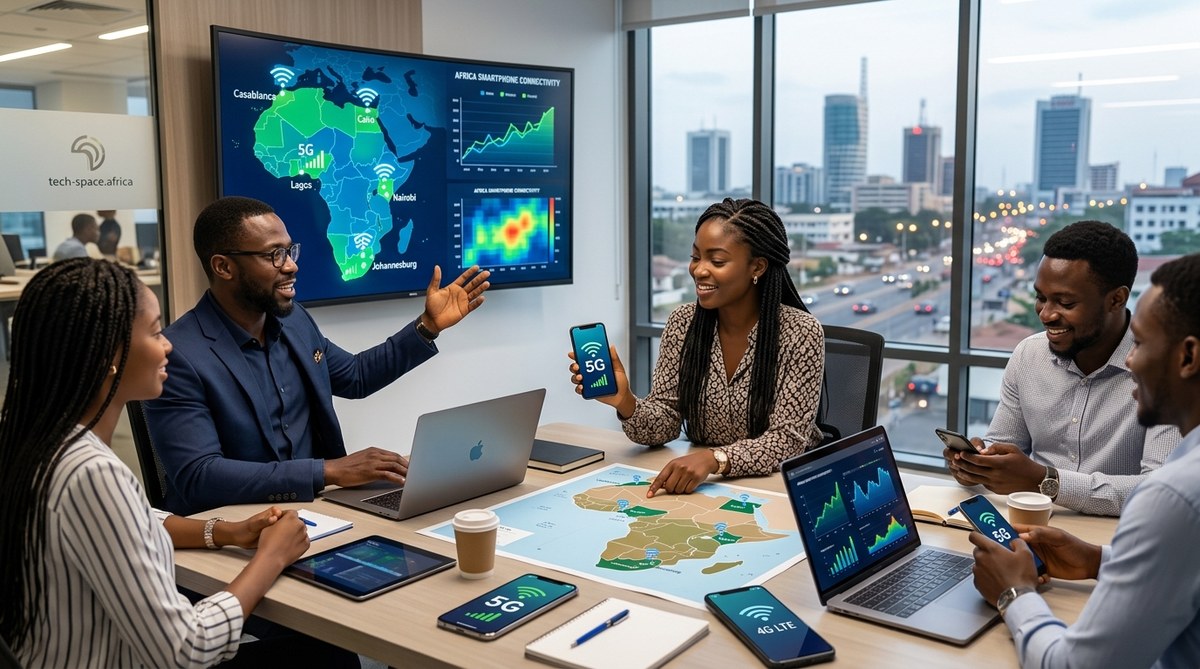
In 2026, the 5G conversation across Africa is no longer about if it will arrive, but how fast it spreads. More than 20 operators in roughly 28 African countries have launched commercial 5G services, yet overall penetration hovers around 3%. That gap between ambition and access tells a story of uneven progress, smart policy moves, and a smartphone market racing to catch up. If you track telecom infrastructure or invest in African tech, knowing which nations are actually leading this shift matters. Let's look at the current leaders, the challenges they face, and what this means for connectivity across the continent.
South Africa, Nigeria, Kenya, Morocco, and Egypt lead the 5G race in Africa as of 2026, together accounting for over 60% of the continent's 5G subscriptions. However, smartphone affordability and spectrum allocation remain the biggest hurdles. Investors should watch markets with clear national broadband plans and growing mid-tier handset demand.
The Current State of 5G in Africa
Africa's 5G journey started later than in North America or East Asia, but the pace has picked up dramatically since 2024. By mid-2026, the GSMA reports that nearly 30 countries have live 5G networks. However, most of these are limited to major cities. Rural 4G coverage still dominates, and in many places, 3G remains the backbone of mobile internet.
The reason is simple. 5G requires dense fiber backhaul and expensive spectrum licenses. African operators, many of whom are still paying off 4G investments, need clear revenue models to justify the upgrade. Yet the demand for high speed data is real. Video streaming, cloud applications, and the rise of remote work are pushing users toward faster networks.
A few countries have broken away from the pack. They invested early in spectrum auctions, partnered with vendors like Huawei and Ericsson, and launched affordable 5G smartphone bundles. Let's break down who is leading and why.
Which African Countries Are Leading the 5G Race?
Here are the top markets for 5G in Africa in 2026, ranked by number of active subscriptions and network coverage.
-
South Africa – South Africa remains the frontrunner. Vodacom and MTN launched 5G in 2020, and by 2026 both operators cover all major metros and many secondary cities. Rain, a data only operator, also offers fixed wireless 5G. The country has the most 5G base stations on the continent. Spectrum allocation, though delayed for years, finally happened in 2022, giving operators the airwaves they needed.
-
Nigeria – Nigeria overtook South Africa in total 5G subscriptions in late 2025. MTN Nigeria and Mafab Communications both rolled out services aggressively. Lagos, Abuja, and Port Harcourt have good coverage. The key driver is smartphone penetration: Nigeria added over 10 million 5G capable devices in 2025 alone. The government's National Broadband Plan 2020–2025 helped set targets, but progress continues through 2026.
-
Kenya – Safaricom launched 5G in 2022 and now covers Nairobi, Mombasa, and several towns. The operator used a creative strategy: it offered 5G fixed wireless access for homes before expanding mobile. Kenya's mobile money ecosystem (M-Pesa) creates natural demand for low latency payments, a perfect use case for 5G.
-
Morocco – Morocco leads North Africa. Maroc Telecom and Orange Morocco launched 5G in 2023 and now cover Casablanca, Rabat, and Tangier. The country's strong tourism sector drives demand for high speed connectivity in hotels and resorts. Morocco also benefits from stable regulatory environment and early spectrum auctions.
-
Egypt – Egypt entered the 5G game later, with Orange Egypt launching services in early 2025. The government's Digital Egypt strategy pushed infrastructure investment. Cairo and Alexandria now have limited 5G coverage, but operators plan to expand to tourist areas along the Red Sea.
-
Ghana – Ghana launched 5G in early 2026 via a consortium called Next Gen InfraCo, a joint venture between local operators and a private investment firm. The rollout is still in early stages, but Accra and Kumasi are connected. Ghana's approach of a shared infrastructure model could be a blueprint for other mid sized markets.
-
Ethiopia – Ethiopia is a wildcard. Safaricom Ethiopia launched 5G in Addis Ababa in 2025. The country's large population and low current penetration mean huge potential, but regulatory hurdles and foreign exchange shortages slow progress.
This is not an exhaustive list. Other countries like Tanzania, Côte d'Ivoire, Senegal, and Botswana have test networks or limited commercial launches. But the gap between the top five and the rest remains wide.
What Drives 5G Adoption in These Markets?
Several factors separate the leaders from the laggards.
-
Government spectrum policy – Countries that auctioned spectrum early and at reasonable reserve prices saw faster deployments. South Africa's ICASA, after years of delays, finally released spectrum in 2022. Nigeria's NCC moved quickly. Morocco's regulator ANRT held timely auctions. In contrast, markets where spectrum remains tied up in legal battles or where prices are too high stall.
-
Smartphone affordability and financing – A 5G smartphone still costs more than a 4G model, though prices have dropped. In Nigeria and Kenya, operators partner with handset makers to offer device financing through airtime plans. This lowers the upfront cost. As noted in our guide on Top 10 Budget Smartphones Dominating the African Market in 2026, models under $200 are now 5G capable, which expands the addressable market.
-
Demand for high speed data – African users are heavy consumers of video. YouTube, TikTok, and streaming services like Showmax and Netflix drive data usage. 5G reduces buffering and enables high definition streaming on mobile. In markets with young, urban populations, this demand is insatiable.
-
Fixed wireless access – Many African homes lack reliable fixed broadband. Operators use 5G fixed wireless as a substitute. In South Africa, Rain's fixed 5G service competes with fiber. In Kenya, Safaricom's fixed wireless 5G is popular in suburbs. This dual use case justifies the investment.
The Role of Smartphone Affordability in 5G Connectivity
You cannot have 5G without 5G phones. And for most Africans, the phone is the primary (often only) internet device. As of 2026, roughly 45% of smartphones sold in Africa are 5G capable, up from 20% in 2023. But that still leaves half the market on 4G.
The challenge is price. While flagship devices cost over $800, the sweet spot for mass adoption is $100 to $200. Chinese brands like Tecno, Infinix, and Xiaomi have flooded the market with sub $200 5G models. Samsung also offers its Galaxy A series with 5G at lower price points.
Operators are stepping in. In Nigeria, MTN offers the "5G Smartphone Plan" where customers pay a monthly fee over 12 months and get a free or heavily subsidized phone. This model works because it ties the user to a postpaid plan, increasing average revenue per user.
For a deeper look at choosing the right device for your needs, see How to Choose the Right Smartphone for Your Business in Africa. And for trends shaping the market, read The Future of Smartphone Technology in Africa: Trends to Watch in 2026.
Challenges That Hold Back 5G Expansion
Even in leading countries, 5G is not everywhere. Rollout faces real obstacles. The table below outlines common techniques used to accelerate deployment and the mistakes that slow it down.
| Technique for Faster 5G Deployment | Common Mistake to Avoid |
|---|---|
| Shared infrastructure models (like Ghana's Next Gen InfraCo) | Each operator building separate towers, duplicating costs |
| Spectrum sharing between operators (dynamic spectrum sharing) | Holding spectrum idle while waiting for full clearance |
| Offering fixed wireless access alongside mobile 5G | Treating 5G as only a mobile play, ignoring home broadband |
| Partnering with local smartphone brands for affordable bundles | Relying only on high end devices that few can afford |
| Using low band spectrum (e.g., 700 MHz) for wider coverage | Focusing exclusively on high band mmWave, which has poor range |
"The countries that succeed with 5G are the ones that treat it as an infrastructure project, not just a marketing upgrade. They align spectrum policy, device affordability, and use cases from day one." - Industry analyst comment from GSMA's Mobile Economy Africa 2026 report.
Another major challenge is electricity. 5G base stations consume more power than 4G. In markets where grid power is unreliable, operators must invest in diesel generators or solar backups, which increases operating costs. This is a non trivial issue in countries like Nigeria and the DRC.
How Investors Can Spot 5G Opportunities in Africa
If you are a tech savvy investor or researcher, you want to know where the returns are. The obvious play is telecom operators in leading markets. But there are other angles.
- Infrastructure providers – Companies that build towers, fiber backhaul, and data centers benefit from 5G buildout. IHS Towers and Helios Towers are active across Africa.
- Smartphone distributors – As 5G phones become standard, distributors with strong relationships with Chinese OEMs stand to gain.
- Fintech and payment companies – 5G enables faster, more reliable mobile money transactions. This benefits platforms like M-Pesa, Airtel Money, and PalmPay. For related trends, see Exploring the Future of Digital Payments in Africa and Top Fintech Startups Revolutionizing Banking in Africa.
- Content and streaming services – Lower latency and higher speeds make video streaming more viable. Local content platforms like Showmax or iROKOtv could see subscriber growth.
The risk is regulatory uncertainty. Spectrum license terms can change, taxes on mobile services can rise, and import duties on smartphones can stifle adoption. Investors should look for markets with stable telecom regulators and clear national digital agendas.
What the Future Holds for African Countries and 5G
By 2028, the GSMA projects that 5G will account for about 10% of mobile connections in Sub Saharan Africa, up from under 3% today. That is still far below the global average of 40%, but the growth trajectory is steep. The leaders will likely stay ahead, but new entrants like Ethiopia and Ghana could leapfrog if they execute well.
The real prize is not just faster phones. It is the services that 5G enables: remote healthcare, precision agriculture, smart city infrastructure, and immersive education. These applications require reliable, low latency connectivity, something 4G struggles to deliver at scale.
For entrepreneurs and startup founders, the message is clear. Build your product with 5G in mind, even if your current users are on 4G. The network is coming. And the smartphone that connects to it is getting cheaper every year. If you are curious about how African consumers are shaping device innovation, check out How African Consumers Are Shaping the Future of Smartphone Innovation in 2026.
5G in Africa is a marathon, not a sprint. But the runners at the front are pulling away. For investors, researchers, and tech professionals, the smart move is to watch the leaders, learn from the challenges, and position yourself where the signal is strongest.