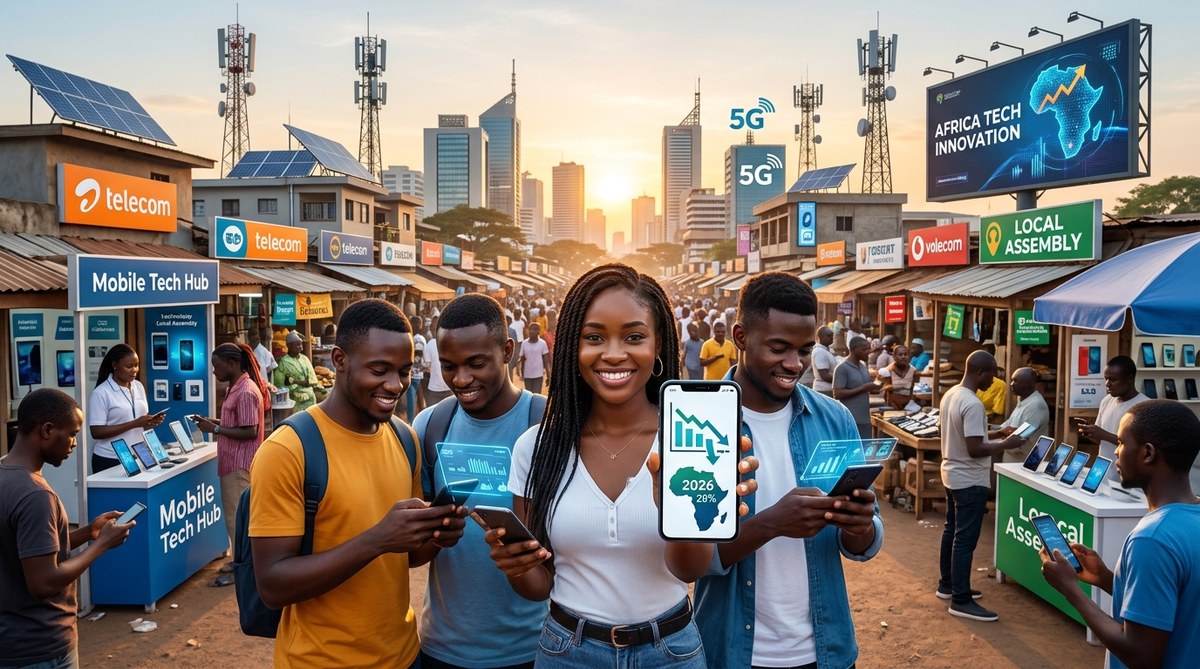
The average price of a mid-range smartphone in Lagos, Nairobi, or Johannesburg has fallen by nearly 35% in the last eighteen months. That is not a typo. While global markets see modest annual declines of 5% to 8%, Africa is experiencing a price correction that feels more like a fire sale. For investors and analysts tracking emerging markets, this shift signals a structural change in how mobile technology reaches the world’s fastest-growing consumer base.
Smartphone prices are dropping faster in Africa than anywhere else in 2026 due to a perfect storm of local assembly plants, intense competition from Chinese brands, falling component costs, and a booming refurbished market. This price collapse is unlocking digital access for millions and reshaping the investment landscape for startups across the continent. The trend is structural, not temporary.
The Price Crash Is Real and It Is Measurable
Let us look at the numbers. In January 2025, a decent 4G smartphone with 4GB of RAM and a 13-megapixel camera cost around $120 in Kenya. By March 2026, the same spec phone sells for $78. That is a 35% drop in just over a year. In the United States, comparable entry-level phones dropped from $150 to $135 over the same period, a 10% decline. India, another price-sensitive market, saw a 15% drop.
Why is Africa different? The answer involves four converging forces.
- Local assembly plants have reached scale. Countries like Ethiopia, Rwanda, and Nigeria now host factories that snap together phones from imported kits. This avoids hefty import duties that used to add 25% to 30% to the final price.
- Chinese brands like Tecno, Itel, and Xiaomi are fighting a price war. They are not just competing with Samsung and Apple. They are competing with each other. Each new model undercuts the last.
- The cost of key components, especially memory chips and entry-level processors, has fallen due to a global oversupply. Africa benefits disproportionately because the phones sold here use last-generation chips that are now abundant and cheap.
- The refurbished smartphone market has matured. Companies like Verity and Naspers-backed ventures have built supply chains that bring high-quality used phones from Europe and the US to African markets at prices that undercut new devices by 40% to 60%.
Local Assembly Is the Game Changer
The single biggest factor driving down prices is the rise of local manufacturing. In 2021, only a handful of phones were assembled in Africa. By 2026, over 20 million units per year are assembled in facilities across the continent.
Consider what happens when a phone is assembled in Nairobi instead of Shenzhen. The import duty on a completely built phone can be 30%. The duty on components is often under 5%. That 25% gap goes straight to the consumer’s wallet.
| Factor | Imported Phone | Locally Assembled Phone |
|---|---|---|
| Import duty | 25% to 30% | 5% to 8% (on parts) |
| Shipping cost | $3 to $5 per unit | $0.50 to $1 per unit |
| Warranty support | Limited (centralized) | Local service centers |
| Price to consumer | Higher | 20% to 35% lower |
Countries like Egypt and Morocco have also joined the trend. The Moroccan government offers tax holidays for tech manufacturers, which further lowers the final price.
The Battle of the Budget Brands
Walk into any phone market in Accra or Kampala and you will see a wall of brands you might not recognize in the US. Tecno, Itel, Oraimo, and M-KOPA are household names. These brands target the sub-$100 segment with aggressive pricing.
Tecno’s latest model, the Spark 10, launched at $89 in early 2026. Six months later, it was selling for $72. The company does not make its money on hardware. It makes money on pre-installed apps, data partnerships, and financing plans.
“We sell the phone at cost or even at a slight loss,” says a product manager for a major Chinese brand operating in West Africa. “The profit comes from the ecosystem. Every phone is a portal to services. Music streaming, mobile money, and content subscriptions. That is where the real revenue lives.”
This model works because African consumers are heavy users of mobile financial services. In 2026, over 60% of smartphone owners in Kenya use their device for mobile payments daily. The phone becomes a tool for commerce, not just communication.
Refurbished Phones Are Eating the New Phone Market
New phones are not the only story. The refurbished market in Africa is growing at 40% per year. A refurbished iPhone 12 that sold for $550 in 2023 now goes for $280 in Lagos. That is a price point that puts premium hardware in the hands of users who could never afford it new.
Refurbishers have gotten better at their craft. They now offer warranties, replace batteries, and use original screens. The quality gap between a new budget phone and a refurbished premium phone has narrowed.
For investors, this creates a fascinating dynamic. The total addressable market for smartphones in Africa is expanding rapidly, but the average selling price is falling. Unit volumes are up, but revenue per phone is down. Startups that depend on phone sales need to adapt. Those that focus on services, content, and financing are thriving.
What This Means for Startups and Investors
If you are a startup founder or investor, the dropping price of smartphones in Africa is a tailwind. Here is why.
- A lower barrier to entry means more users. Every price drop of $10 adds millions of potential customers to the digital economy.
- Cheaper phones accelerate the shift to mobile-first services. Fintech, e-commerce, and education apps benefit directly.
- The refurbished market creates a circular economy. Companies that can source, repair, and distribute used phones have a massive opportunity.
Check out our guide on how African startups are building a smartphone resale economy that rivals new phone sales in 2026 for a deeper look at this trend.
Three Practical Steps for Market Analysts and Investors
If you are tracking this space, here is how to make sense of the data.
- Track local assembly volumes by country. The countries with the fastest-growing assembly capacity will see the steepest price drops. Ethiopia, Nigeria, and Egypt are the ones to watch.
- Monitor the price of entry-level 4G phones in the $50 to $100 range. That is the sweet spot for mass adoption. A drop below $50 would be a historic milestone.
- Watch the refurbished supply chain. If companies start offering one-year warranties on used phones, the new phone market will face even more pressure.
The Role of 5G and Future Pricing
Many analysts expected 5G to keep prices high. That has not happened. In 2026, 5G phones are available in Africa for under $150. The reason is that chipmakers like MediaTek and Qualcomm have integrated 5G modems into their budget platforms. The cost difference between a 4G and a 5G chip has shrunk to under $15.
For consumers in cities like Cape Town, Nairobi, and Accra, 5G coverage is expanding. The combination of cheap 5G phones and growing network coverage will drive the next wave of adoption. But the real action remains in the sub-$100 segment, where 4G phones still dominate.
Common Mistakes to Avoid When Analyzing This Market
| Mistake | Why It Is Wrong |
|---|---|
| Assuming price drops mean lower quality | Local assembly often improves quality because defects are caught before shipping |
| Ignoring the refurbished segment | Refurbished phones now account for 25% of all smartphone sales in Africa |
| Treating Africa as one market | Prices in Morocco differ wildly from prices in Malawi due to logistics and tax policies |
| Focusing only on new phone sales | Revenue from services and financing often exceeds hardware margins |
The Bottom of the Pyramid Is Growing
The most exciting part of this price collapse is who it reaches. Rural farmers in Uganda, market vendors in Ghana, and students in rural Zambia are buying smartphones for the first time. These are not early adopters. They are late adopters who were priced out until now.
When a farmer in rural Tanzania buys a $50 smartphone, they gain access to weather forecasts, market prices, and mobile money. That phone can increase their income by 20% in a single growing season. The economic multiplier effect is enormous.
For startups building for this audience, the key is simplicity. These users often have limited data plans and older phones. Apps need to be lightweight, work offline, and use minimal bandwidth. The top 10 budget smartphones dominating the African market in 2026 are all optimized for this exact use case.
The Price Drop Is Not a Bubble
Some investors worry that the price drops are unsustainable. They ask: what happens when component prices rise again? The answer is that local assembly and competition are structural, not cyclical. Even if chip prices rise, the savings from local assembly and the pressure from brand competition will keep prices low.
Furthermore, the refurbished market acts as a price ceiling. If new phones get too expensive, consumers simply buy used. This keeps the entire market honest.
What the Data Tells Us About 2026 and Beyond
Let us look at a simple projection. If current trends hold, the average price of a new smartphone in Africa will fall below $70 by the end of 2027. That would put a connected device within reach of over 400 million people who currently rely on feature phones or no phone at all.
For comparison, the average price in India is expected to hit $90 by then. Africa will be the cheapest place on earth to buy a smartphone. That is a remarkable reversal from just five years ago, when African consumers paid a premium for the same devices sold in Europe.
A Final Look at the Forces at Play
To summarize the key drivers:
- Local assembly plants in Ethiopia, Nigeria, Egypt, and Rwanda
- Price wars between Chinese brands like Tecno, Itel, and Xiaomi
- Falling cost of memory and processors
- A mature and growing refurbished market
- The shift to service-based revenue models that subsidize hardware
Each of these forces is independent. Together, they create a market where prices keep falling even as quality improves.
What This Means for Your Next Investment Decision
If you are a venture capitalist or angel investor looking at African tech, pay close attention to companies that are building on top of this smartphone boom. The hardware is becoming a commodity. The value is in the software, services, and financial products that run on it.
Consider the top fintech startups revolutionizing banking in Africa. These companies are thriving because the smartphone is becoming the primary banking interface for millions of people. Every price drop adds new customers to their addressable market.
Similarly, emerging trends every African startup founder needs to watch in 2026 all point in the same direction: cheaper phones, more users, and a mobile-first economy.
The Smartphone Is the Gateway
Think of the smartphone as the key that unlocks the digital economy. In the US, that key was handed out years ago. In Africa, it is being sold at a discount. The price drop is not just a consumer win. It is an infrastructure play. Every phone sold is a new node in a network that enables commerce, education, healthcare, and finance.
For the analyst tracking global tech trends, Africa is no longer a lagging market. It is a leading indicator of what happens when price barriers fall. The lessons learned here will apply to other emerging markets in South Asia and Latin America.
Looking Ahead
The forces driving smartphone prices dropping Africa 2026 are not fading. Local assembly capacity is still scaling. Competition is still fierce. Component costs are still falling. And the refurbished market is still growing.
The only question is how low prices can go. Some analysts predict a $40 smartphone by 2028. If that happens, the continent will see a digital revolution unlike anything we have witnessed. The time to pay attention is now.
For a closer look at the devices leading this charge, browse our list of best smartphones for African entrepreneurs in 2026. And if you are curious about the repair side of the equation, smartphone repair costs in Africa are dropping for many of the same reasons.
The story of smartphone prices in Africa is a story of access. It is about removing the toll gate that kept millions out of the digital world. That gate is now open, and the traffic is just starting to flow.