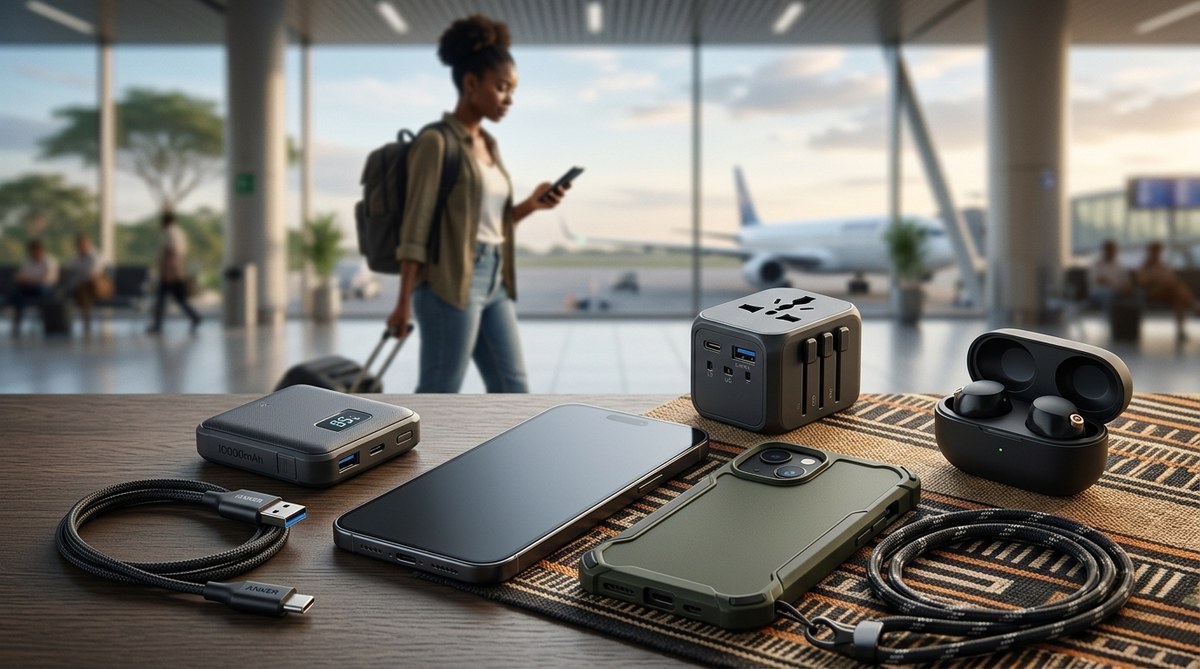
Your smartphone is probably the most important item you pack for a trip to Africa. It handles your maps, your photos, your communication, and your payments. But Africa throws challenges at your phone that a typical city commute does not. Dust on safari trails, power outages in remote lodges, and multiple plug types across different countries can all ruin your day. The right accessories turn those problems into non-issues. Here are the five pieces of gear that make the biggest difference for travelers in Africa right now.
Traveling through Africa with a smartphone is easier when you have the right gear. This guide covers five essential accessories for 2026: solar-ready power banks, portable Wi-Fi hotspots, dust-proof cases, universal adapters, and all-in-one cable kits. These items handle Africa’s unique challenges like power outages, dust, and varying outlets. Whether you are on safari or exploring cities, these accessories keep you powered, connected, and protected.
Power When You Need It Most
Power outages happen in many parts of Africa. Even in cities with stable grids, lodges and guesthouses sometimes run on generators that shut off at night. A standard power bank helps, but you need something built for longer stretches.
Look for a power bank with at least 20,000 mAh capacity. That gives you four to five full phone charges. More importantly, find one with solar charging capability. Solar panels on power banks are slower than wall charging, but they work when you are on a multi-day safari or hiking trip with no electricity at all.
A good solar power bank should also have:
– Two USB output ports so you can charge your phone and a friend’s device at the same time
– A built-in LED flashlight (helpful during evening power cuts)
– Pass-through charging so the bank itself charges while it charges your phone
– Dust flaps covering the ports
Some premium models now include a small digital display that shows remaining battery percentage. That feature saves you from guessing whether you have enough juice for the night.
“I spent three weeks in rural Tanzania with nothing but a solar power bank and a cheap feature phone as backup. The solar bank kept my main smartphone alive for the entire trip. I charged it during the day while hiking and used it at night for maps and photos. It is the single most important accessory for anyone traveling outside major African cities.” — Sam Njoroge, travel tech blogger based in Nairobi
If you want to learn more about keeping your phone alive in tough conditions, read our guide on how to extend your smartphone’s battery life in Africa’s harsh climate.
Stay Connected Anywhere
Cell coverage in Africa varies wildly. You can have 5G in downtown Nairobi or Lagos, then drop to 2G thirty minutes outside the city. A portable Wi-Fi hotspot or a good eSIM adapter solves this problem.
Many travelers buy a local SIM card when they arrive. That works, but it means juggling physical SIMs and potentially losing your home number. A dual-SIM phone with eSIM support is the cleaner option. You keep your home number on the physical SIM and buy a local data plan on the eSIM.
For areas with weak signal, a portable hotspot with an external antenna port makes a real difference. These devices pull in signals that your phone cannot catch on its own. Some models even support Wi-Fi calling, which helps when voice signal is poor but data is available.
Here is a simple process for setting up connectivity before your trip:
- Check if your phone supports eSIM. Most flagship models from 2023 onward do.
- Download an eSIM app like Airalo or Holafly before you leave home.
- Buy a regional Africa plan that covers multiple countries if you visit more than one.
- Keep a physical SIM from a local carrier as a backup for remote areas.
- Test your connection at the airport before heading to your final destination.
For a deeper look at which countries offer the best networks, see our article on 5G or not: which African countries are leading smartphone connectivity.
Protection Against Dust, Sand, and Rain
Africa is dusty. Safari vehicles kick up red dirt that finds its way into every pocket and bag. Sand at coastal beaches scratches screens. Sudden rainstorms catch you off guard. A standard phone case is not enough.
You need a case with an IP68 rating. That means it is fully dust-tight and can survive submersion in water. Many rugged cases also include a built-in screen protector and port covers that keep dust out of your charging port and headphone jack.
Here are the features to look for in a travel-ready phone case for Africa:
– IP68 or MIL-STD-810G military-grade drop protection
– Raised edges around the camera lens and screen
– Port covers made of soft rubber that seal tightly
– A lanyard attachment point so you can wear your phone around your neck
– Compatibility with wireless charging so you do not have to remove the case
Some travelers prefer a waterproof pouch instead of a case. Pouches are great for beach days and boat trips, but they make it hard to use the touchscreen. A good rugged case is better for everyday use because you can still interact with your phone normally.
If you are still deciding which phone to bring, check our list of top 10 budget smartphones dominating the African market in 2026. Many of those models work great with rugged cases.
One Adapter That Fits Every Outlet
Africa has no single plug standard. Southern Africa uses the South African three-prong round plug. East Africa often uses British-style three-prong rectangular plugs. West and North Africa use European two-round-pin plugs. You might cross three different plug zones on a single trip.
A universal travel adapter solves this, but not all adapters are equal. Cheap ones feel loose in the socket and can damage your devices. Look for an adapter with these qualities:
| Feature | Why It Matters for Africa |
|---|---|
| Surge protection | Power surges happen during storms and grid switches in many African cities |
| Dual USB-C and USB-A ports | Charge your phone and camera or tablet at the same time |
| Compatible with British, European, and South African outlets | Covers almost every country on the continent |
| Built-in fuse | Protects your devices if the voltage spikes |
| Compact size | Fits in a small pocket without adding weight |
Some adapters now include a small LED that shows whether the outlet has proper grounding. That is a nice bonus for older buildings where wiring may be dated.
Do not buy a separate adapter for each country. A single good universal unit handles everything. Just make sure it supports the voltage in Africa (220-240V). Most modern phone chargers are dual-voltage, so you do not need a voltage converter for your phone.
For help picking the right phone for your trip, read our guide on how to choose the right smartphone for your business in Africa. The same principles apply to travel.
The Cable Kit That Does It All
Cables are easy to forget and easy to break. A cheap cable that fails mid-trip means you cannot charge your phone until you find a store that sells a replacement. In rural Africa, that could take hours or days.
Build a small cable kit before you leave. Keep it in a dedicated pouch so you never have to hunt for it.
Your kit should include:
– One USB-C to USB-C cable rated for 100W charging (works for most modern phones and laptops)
– One USB-C to Lightning cable if anyone in your group uses an older iPhone
– One micro-USB cable as a backup (some power banks and budget phones still use this)
– A short 6-inch cable for connecting to power banks without creating a mess of slack
– A braided nylon cable for durability (the braided ones last much longer than rubber cables)
Braided cables resist the twisting and bending that happens when you stuff them into a backpack. They also handle heat better if you leave them in a car. Spend a few extra dollars on good cables and they will last for years.
Organize your cables with a small velcro strap or a silicone cable tie. That keeps them from tangling with each other and makes them easier to find in your bag.
Putting It All Together
The best smartphone accessories for African travelers in 2026 solve real problems. They keep your phone charged when the grid goes down. They protect it from dust and water. They help you stay connected across different networks and countries. And they fit in a single small pouch that does not weigh you down.
Here is your packing checklist for the five essentials:
- A 20,000 mAh solar power bank with dual outputs and a flashlight
- An eSIM setup or portable Wi-Fi hotspot with regional coverage
- An IP68 rugged case with port covers and a lanyard
- A universal travel adapter with surge protection and multiple port types
- A braided cable kit with USB-C, Lightning, and micro-USB options
These five items cover the vast majority of situations you will face while traveling in Africa. They are small, affordable, and they make a huge difference in how smoothly your trip goes.
Your Trip Deserves Reliable Gear
Africa changes you. The landscapes, the people, the food, the pace of life. But your phone should not change how it behaves just because you crossed a border. With the right accessories, it works the same way it does at home. That means less stress and more focus on the experience itself. Pack these five items, charge everything before you leave, and get ready for an unforgettable journey.