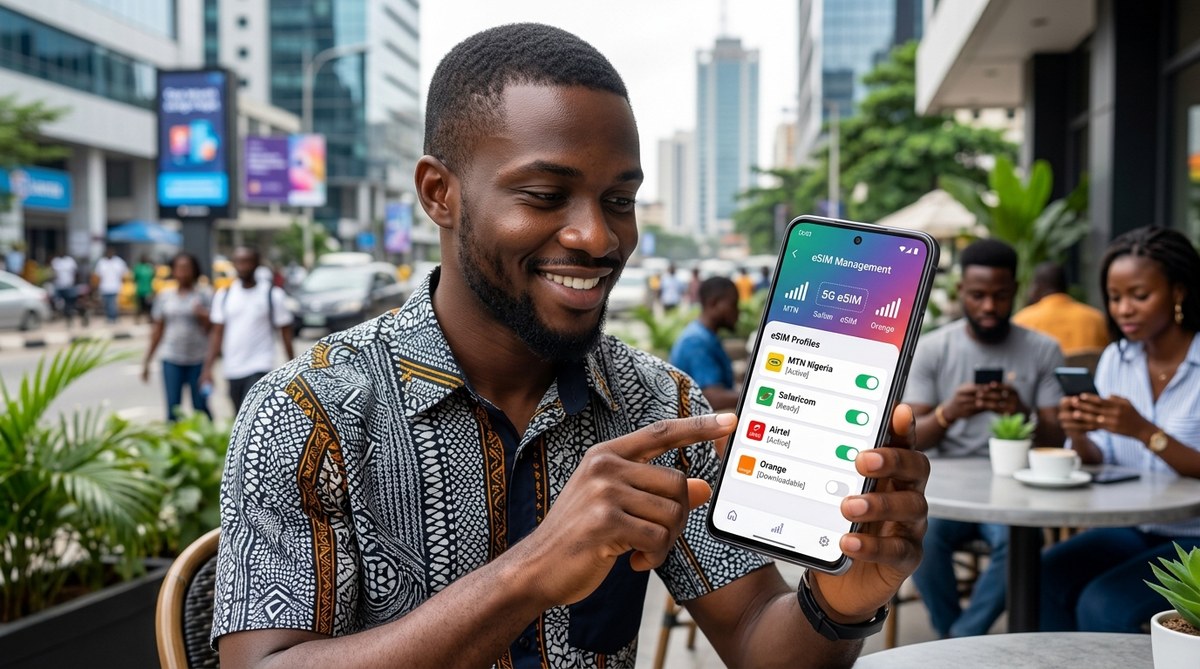
The first time you cross a border in Africa and your phone goes silent, you feel it. That moment of panic as you realize your data bundle doesn’t work here. You scramble to find a vendor. You haggle for a physical SIM. You swap tiny plastic cards in the sun, hoping you do not drop the old one in the dust. For millions of smartphone users across South Africa, Kenya, and Nigeria, that frustrating ritual is finally ending. In 2026, the shift to eSIM technology is not just a trend. It is a practical response to high roaming costs, unreliable physical SIM cards, and the growing need for seamless connectivity across the continent.
African smartphone users are switching to eSIMs in 2026 to avoid expensive roaming fees, eliminate the hassle of buying physical SIMs at every border, and gain the freedom to switch carriers instantly. With more affordable data plans and wider device support, eSIMs offer a smarter way to stay connected across countries like South Africa, Kenya, and Nigeria.
The Real Cost of Roaming in Africa
Roaming charges in Africa can feel like a penalty for traveling. A Nigerian professional flying to Nairobi for a conference might pay double or triple the local rate for data. A South African tourist exploring Zanzibar often returns to a shocking bill. The math does not work in your favor.
Physical SIM cards are a workaround, but they come with their own problems. You need to find a store. You need to register your ID. You need to keep track of multiple numbers. And when you travel back home, you often forget which SIM is active. An eSIM solves this by storing your profile digitally. You can buy a local data plan before you even land. No plastic. No queues. No surprise charges.
How an eSIM Actually Works
If you are new to the idea, here is a simple breakdown. An eSIM is a small chip built into your phone. It acts like a blank canvas. Instead of inserting a physical card, you download a carrier profile over the internet. Your phone then connects to that network.
Here is a numbered list of the practical steps to get started:
- Check if your phone supports eSIM. Most mid-range and premium smartphones released after 2020 have it. Look in your settings under “Mobile Networks” or “SIM Management.”
- Choose a provider that covers your destination. Many global eSIM brands now offer specific Africa plans.
- Purchase a plan online. You will receive a QR code or an activation link.
- Scan the QR code with your phone’s camera. The profile installs automatically.
- Activate the plan when you arrive. Your phone switches to the new network without touching any hardware.
The whole process takes less than five minutes. No tiny trays. No paperclips.
Why African Users Are Making the Switch in 2026
The reasons go beyond convenience. Here are the main drivers behind the shift:
- Roaming cost savings. Local eSIM data plans are often 50 to 70 percent cheaper than international roaming add-ons.
- Dual SIM capability. You can keep your home number active for calls and use the eSIM for data. No need to abandon your main line.
- Instant switching. If a network is slow, you can buy a new plan from a different provider without visiting a shop.
- Security. A stolen phone with a physical SIM can be used to bypass two-factor authentication. An eSIM is tied to your device and harder to tamper with.
- Environmental impact. Fewer plastic SIM cards means less waste. It is a small change, but it adds up across millions of users.
For entrepreneurs and remote workers who cross borders regularly, the value is even higher. You can read more about how emerging smartphone features are transforming connectivity in Africa to understand the bigger picture.
Physical SIM vs. eSIM: A Side-by-Side Comparison
This table breaks down the key differences for African smartphone users.
| Feature | Physical SIM | eSIM |
|---|---|---|
| Activation speed | Requires store visit and ID registration | Instant via QR code or app |
| Roaming costs | High daily fees | Local rates on demand |
| Number of profiles | One per card | Multiple profiles stored digitally |
| Switching carriers | Buy new card, swap hardware | Download new profile remotely |
| Security risk | Card can be removed and used in another phone | Tied to device, harder to clone |
| Environmental waste | Plastic card and packaging | Zero physical waste |
Common Mistakes When Switching to eSIM
Adopting new tech always comes with a learning curve. Here are a few pitfalls to avoid:
“Do not delete your primary eSIM profile while traveling. If you lose signal, you will have no way to download a new one. Keep your home profile active until the new plan is confirmed working.” — Advice from a Kenyan tech blogger who switched in early 2026.
- Assuming all phones are compatible. Some budget smartphones in Africa still lack eSIM hardware. Always verify before buying a plan.
- Buying a regional plan that does not cover your destination. Some “Africa” plans skip smaller countries. Read the coverage list carefully.
- Forgetting to disable your home line data. If both SIMs are active, your phone might still use roaming data. Set the eSIM as the default for data.
- Not saving your activation QR code. If you reset your phone, you might need to reinstall the profile. Keep the code in a secure note.
What About Mobile Money?
One valid concern is that eSIMs do not replace the need for a local number tied to mobile money services like M-Pesa or Airtel Money. If you rely on these services, keep your home SIM active for transactions. Use the eSIM for data only. Most modern phones support dual standby, meaning both lines stay on at the same time. This approach gives you the best of both worlds.
If you are still using an older device, you might want to check out the top 10 budget smartphones dominating the African market in 2026 to find an eSIM-compatible upgrade that fits your budget.
The Network Landscape Across Africa
Not all carriers support eSIM equally. In South Africa, Vodacom and MTN have rolled out eSIM support for postpaid and prepaid users. In Kenya, Safaricom offers eSIM activation through its app. In Nigeria, MTN and Airtel are catching up, though availability varies by region. The good news is that global eSIM providers like Airalo and Holafly now include strong African coverage, with local partners in over 30 countries.
The shift is also driven by the future of smartphone technology in Africa. As more devices ship with eSIM as standard, the infrastructure will only improve.
Your Next Step Toward Smarter Connectivity
If you are still carrying a stack of physical SIM cards for different countries, 2026 is the year to simplify. Start by checking your phone’s compatibility. Pick one trip and try an eSIM for that destination. The cost is low. The setup is painless. And the freedom of landing in a new country with data already working is something you will not want to give up.
The switch to eSIM in Africa is not about following a trend. It is about choosing a tool that matches how you actually live and work. Give it a try on your next trip. You might be surprised how much lighter your pocket feels.